

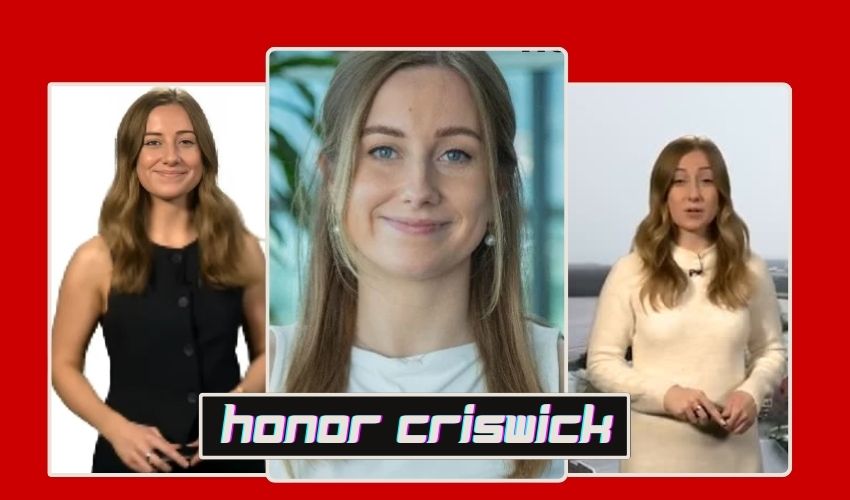
- Honor Criswick is a professionally trained meteorologist working within the UK Met Office.
- She combines operational forecasting with on-air weather presentation.
- Her career reflects the growing importance of scientist-led weather communication.
- She represents a new model of public-facing meteorology grounded in data and accountability.
- Her work influences sectors ranging from aviation to public safety.
Who is Honor Criswick?
Honor Criswick is a UK-based operational meteorologist and weather presenter, best known for her work with and for her appearances on national broadcast platforms. Unlike presenters who focus solely on delivery, Criswick operates within the forecasting system itself—working directly with meteorological data, numerical weather prediction models, and risk-based decision frameworks that underpin official UK forecasts.
The Role She Actually Performs (Beyond the Screen)
A common misconception in broadcast meteorology is that presenters simply relay information prepared by others. In Criswick’s case, that assumption does not hold. As an operational meteorologist, she is involved in the forecasting pipeline itself—interpreting model outputs, assessing uncertainty, and contributing to forecasts that carry real-world consequences.
Operational meteorologists at the Met Office support high-impact sectors including:
- Aviation – weather guidance affecting flight planning and safety
- Emergency planning – storm, flood, and heatwave warnings
- Agriculture – timing decisions linked to rainfall, frost, and temperature
According to Met Office documentation, weather-related disruptions cost the UK economy billions annually, particularly in transport and infrastructure. Accurate forecasting—and clear communication of uncertainty—reduces these risks. Criswick’s role sits directly within that responsibility chain.
Academic and Professional Foundations
From Geography to Applied Meteorology
Honor Criswick’s training follows a standard but demanding UK meteorological pathway. She completed an undergraduate degree in Geography, followed by a Master’s in Applied Meteorology and Climatology. This postgraduate route is widely recognised as one of the primary pipelines into operational forecasting roles.
Applied meteorology programmes emphasise:
- Atmospheric dynamics and thermodynamics
- Numerical weather prediction (NWP) models
- Forecast verification and uncertainty communication
- Real-time decision-making under pressure
Progression Within the Met Office
Criswick joined the Met Office in 2019, initially in a technical forecasting support role. By 2022, she progressed to Operational Meteorologist—a promotion that reflects both technical competence and decision-making reliability.
This progression is non-trivial. Internal Met Office standards require demonstrable accuracy, consistency, and the ability to handle forecast uncertainty responsibly before an individual is entrusted with operational sign-off duties.
Why Her Broadcasting Role Is Structurally Different
In 2024, Honor Criswick began appearing as a weather presenter on platforms. What differentiates her from many broadcast figures is that her on-screen explanations are extensions of her operational work, not a separate media function.
This dual-role model offers several advantages:
- Reduced risk of oversimplification or sensationalism
- Clearer explanation of forecast confidence and limitations
- Consistency between official warnings and broadcast messaging
The Met Office itself has increasingly emphasised impact-based forecasting—communicating what weather will do, not just what it will be. Criswick’s broadcasting aligns closely with this philosophy.
Information Gain: What Her Career Signals About Modern Meteorology
Honor Criswick’s visibility is not just about individual popularity. It reflects a broader structural shift in meteorology:
- Public trust is higher when forecasts are delivered by practising scientists.
- Audiences increasingly expect transparency about uncertainty.
- Climate variability has increased demand for clear, contextual explanations.
The UK Met Office consistently ranks among the world’s most accurate forecasting agencies. Maintaining that reputation requires not only technical excellence but effective public communication—especially during extreme weather events. Criswick’s role sits precisely at that junction.
Common Misconceptions Addressed
“Weather presenters just read scripts”
In operational contexts, this is incorrect. Meteorologists like Criswick interpret evolving data up to and during broadcasts. Forecasts may change rapidly, especially during convective or storm-driven events.
“Forecast errors mean incompetence”
All forecasts are probabilistic. Responsible meteorologists communicate risk ranges, not guarantees. Criswick’s communication style reflects this scientific reality rather than offering false certainty.
“Broadcasting reduces scientific credibility”
Within the Met Office model, broadcasting is increasingly viewed as a professional extension of forecasting, not a dilution of it.
Privacy, Professionalism, and Public Focus
Another consistent pattern across search results is curiosity about personal details. Notably, Criswick maintains a clear boundary between professional output and private life. From a credibility standpoint, this is aligned with Met Office guidance and broader public-sector norms.
Her public-facing identity is built almost entirely on:
- Professional qualifications
- Forecast accuracy
- Clear science communication
This approach reinforces trust and keeps attention on the information that materially affects the public.
Practical Takeaways for Readers
- Honor Criswick is not just a presenter—she is an operational meteorologist.
- Her forecasts are grounded in the same systems that issue official UK weather warnings.
- Her career reflects a broader shift toward scientist-led public communication.
- Clear explanation of uncertainty is a feature of good forecasting, not a weakness.
Frequently Asked Questions
Is Honor Criswick a qualified meteorologist?
Yes. She holds postgraduate qualifications in applied meteorology and works as an operational meteorologist within the UK Met Office.
Does she work independently from the Met Office?
No. Her broadcasting work complements, rather than replaces, her operational forecasting role.
Why is she becoming more visible now?
Increased extreme weather events and public demand for trustworthy explanations have elevated the role of scientifically trained presenters.
In summary, Honor Criswick represents a modern, credibility-driven model of weather communication—one where scientific responsibility and public engagement are not competing priorities, but mutually reinforcing ones.