

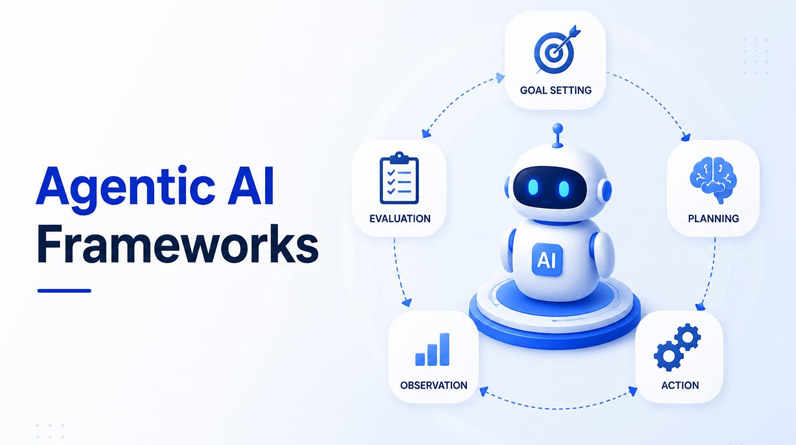
Artificial Intelligence is no longer limited to static models that respond to prompts or execute predefined tasks. The next evolution of AI lies in agentic systems—intelligent entities capable of making decisions, taking actions, learning from outcomes, and operating autonomously toward defined goals. At the core of this transformation are Agentic AI Frameworks, which provide the structure, tools, and orchestration needed to build and deploy such systems at scale, driving advancements in AI development.
From automating enterprise workflows to enabling self-improving digital assistants, agentic AI is redefining how software interacts with users and environments. Businesses are now moving beyond simple automation toward systems that can reason, plan, and act independently—unlocking new levels of productivity and innovation.
What Are Agentic AI Frameworks?
Agentic AI frameworks are development platforms or architectures for creating AI agents that can operate autonomously. These frameworks combine machine learning, natural language processing, decision-making logic, and system integrations to enable AI systems to perform complex, goal-oriented tasks.
Unlike traditional AI models that require continuous human input, agentic systems can:
- Set goals and break them into tasks
- Make decisions based on context
- Interact with external tools and APIs
- Learn from feedback and outcomes
- Adapt behavior over time
These capabilities make agentic AI frameworks ideal for building intelligent systems that go beyond simple automation.
Core Components of Agentic AI Frameworks
Agentic AI systems rely on several key components that work together to enable autonomy and intelligence.
● Goal Definition and Planning Engine
At the heart of any agentic system is its ability to understand objectives and plan actions accordingly. The planning engine breaks down high-level goals into smaller, manageable tasks.
This component ensures that the AI agent follows a structured approach rather than acting randomly. It also enables dynamic adjustments when conditions change.
● Reasoning and Decision-Making Module
Agentic AI frameworks include reasoning engines that allow systems to evaluate options, analyze context, and choose the best course of action.
This module uses techniques such as logic-based reasoning, probabilistic models, and reinforcement learning to make informed decisions. It is what gives AI agents their “thinking” capability.
● Memory and Context Management
Memory plays a critical role in agentic systems. It allows AI agents to retain past interactions, learn from previous actions, and maintain context across tasks.
There are typically two types of memory:
- Short-term memory for immediate tasks
- Long-term memory for learning and adaptation
Effective memory management ensures continuity and improves decision-making accuracy.
● Tool and API Integration Layer
Agentic AI systems often need to interact with external tools, databases, and services. The integration layer allows agents to perform actions such as retrieving data, executing commands, or triggering workflows.
For example, an AI agent could access a CRM system, send emails, or process financial transactions through APIs.
● Execution and Action Module
Once decisions are made, the execution module carries out the required actions. This could involve generating responses, updating systems, or initiating workflows.
The execution layer ensures that the agent’s decisions translate into real-world outcomes.
● Feedback and Learning Mechanism
Agentic AI frameworks include feedback loops that allow systems to learn from their actions. By analyzing results, agents can refine their strategies and improve performance over time.
This continuous learning process is essential for building adaptive and intelligent systems.
Key Features of Agentic AI Frameworks
Agentic AI frameworks offer several advanced features that distinguish them from traditional AI systems. They are designed to operate with greater autonomy, adaptability, and intelligence. These capabilities enable organizations to automate complex processes while maintaining efficiency and control.
● Autonomous Task Execution
Agents can perform tasks independently without constant human intervention, reducing the need for manual effort. This leads to faster execution of repetitive and time-consuming processes. As a result, organizations can improve productivity and focus on higher-value activities.
● Multi-Step Reasoning
Agentic systems can handle complex workflows that require multiple steps and decisions. They are capable of planning, executing, and adjusting actions dynamically based on changing conditions. This makes them highly effective for solving complex, real-world problems.
● Context Awareness
By maintaining memory and context, agents can deliver more relevant and accurate responses. They can recall past interactions and use that information to improve future outputs. This enhances personalization and overall user experience.
● Scalability and Flexibility
These frameworks are designed to scale across multiple use cases, from simple automation to enterprise-level operations. They can adapt to different environments and business needs with ease. This flexibility allows organizations to expand AI usage without major restructuring.
● Human-AI Collaboration
Agentic systems can work alongside humans, assisting with decision-making and task execution. They enhance human productivity by handling routine tasks and providing insights. At the same time, human oversight ensures accuracy, accountability, and better outcomes.
Popular Agentic AI Frameworks
Several frameworks are leading the development of agentic AI systems. These tools provide the foundation for building intelligent, autonomous agents across industries. They simplify integration, orchestration, and scaling of AI-driven workflows.
● LangChain
LangChain is widely used for building AI agents that integrate with external tools and data sources. It supports complex workflows and chaining multiple actions together.
It offers modular components, making it easy to customize agent behavior.
Developers use it extensively for applications like chatbots, retrieval systems, and automation pipelines.
● AutoGPT
AutoGPT enables autonomous AI agents that can generate and execute tasks based on high-level goals. It demonstrates the potential of self-directed AI systems. It can break down objectives into smaller tasks and iterate toward solutions. This makes it useful for experimentation in autonomous decision-making systems.
● CrewAI
CrewAI focuses on multi-agent collaboration, where multiple AI agents work together to achieve a common objective. Each agent can have a specific role, improving task specialization and efficiency. This approach is ideal for complex workflows requiring coordination and teamwork.
● Microsoft Semantic Kernel
This framework integrates AI models with enterprise applications, enabling intelligent automation and decision-making. It supports plugins and connectors to extend functionality across systems. Organizations use it to embed AI into business processes seamlessly.
● OpenAI Agents Framework
Designed for building advanced AI agents, this framework supports reasoning, planning, and tool usage in real-world applications. It enables developers to create highly adaptive and context-aware systems. Its flexibility makes it suitable for both simple automation and complex problem-solving scenarios.
You May Also Like: How to Build an AI Agent: A Complete Guide With Benefits
Use Cases of Agentic AI Frameworks
Agentic AI is transforming multiple industries with its ability to automate complex processes. These systems operate with a degree of autonomy, making decisions and adapting to changing inputs. They help organizations improve efficiency, reduce costs, and enhance overall productivity.
● Customer Support Automation
AI agents can handle customer queries, resolve issues, and escalate complex cases when necessary. They provide 24/7 support, improving customer satisfaction and response times.
Advanced systems can personalize interactions based on customer history and preferences.
● Business Process Automation
Enterprises use agentic AI to automate workflows such as data entry, reporting, and document processing. This reduces human error and speeds up repetitive operational tasks.
It also enables better resource allocation by freeing employees for higher-value work.
● Financial Operations
AI agents can analyze financial data, detect fraud, and automate transactions. They improve accuracy in forecasting and risk assessment. Real-time monitoring helps organizations respond quickly to anomalies and market changes.
● Healthcare Assistance
Agentic systems support diagnostics, patient management, and administrative tasks. They assist healthcare professionals in making faster and more accurate decisions. Automation also reduces administrative burden, allowing more focus on patient care.
● Software Development
AI agents assist developers by generating code, debugging, and managing deployment processes. They accelerate development cycles and improve code quality.
Collaboration between developers and AI tools enhances innovation and efficiency.
Challenges in Implementing Agentic AI Frameworks
Despite their potential, agentic AI frameworks come with several challenges that organizations must address. These systems are inherently complex, requiring careful coordination between multiple components and continuous oversight. Without proper planning, they can introduce risks related to security, control, and performance.
● Complex System Design
Building autonomous systems requires careful architecture and integration of multiple components. These systems often combine models, tools, and workflows, making design and maintenance more difficult. Ensuring smooth interaction between components is essential for reliability. Poor design can lead to errors and inefficiencies. This makes strong technical planning a key requirement.
● Data Privacy and Security
Agentic systems often access sensitive data, making security a top priority. Organizations must implement strict data protection measures to prevent breaches. Handling user data responsibly is essential to maintain trust. Compliance with privacy regulations also adds another layer of complexity. Failing in this area can lead to serious legal and reputational issues.
● Control and Accountability
Ensuring that AI agents act within defined boundaries is critical to avoid unintended consequences. Autonomous behavior can sometimes lead to unpredictable outcomes if not properly constrained. Clear accountability mechanisms help track decisions and actions. This improves transparency and trust in the system. It also enables quicker identification and correction of issues.
● Performance Optimization
Maintaining efficiency and accuracy in complex workflows can be challenging. Agentic systems often operate in dynamic environments that require constant tuning. Balancing speed with accuracy is essential for effective performance. Continuous monitoring and updates help improve system efficiency. Without optimization, performance can degrade over time.
Best Practices for Building Agentic AI Systems
To successfully implement agentic AI frameworks, organizations should follow best practices. Agentic systems can act autonomously, so careful design is essential to ensure safe and predictable behavior. A well-structured approach helps improve performance, reduce risks, and support long-term scalability.
● Define Clear Goals and Constraints
Clearly outline what the AI agent should achieve and set boundaries for its actions. Well-defined goals prevent ambiguity and guide decision-making, while constraints ensure the system operates within safe and ethical limits. This reduces the chances of unintended behavior and makes evaluation and optimization more effective.
● Implement Strong Monitoring Systems
Monitor agent behavior to ensure accuracy and reliability. Continuous monitoring helps detect errors and unexpected actions early, enabling teams to refine performance over time. Proper logging and alert systems also improve transparency and maintain alignment with intended objectives.
● Focus on Security and Compliance
Protect sensitive data and ensure compliance with regulations. Strong security practices help prevent unauthorized access and data breaches, while adherence to legal standards builds trust with users and stakeholders. This approach also minimizes potential legal and operational risks.
● Start Small and Scale Gradually
Begin with simple use cases and expand as the system matures. Starting small allows teams to validate functionality and reduce initial complexity. Gradual scaling makes it easier to incorporate learnings and improvements, resulting in more stable and efficient AI deployments over time.
How Moon Technolabs Helps Build Agentic AI Solutions
Moon Technolabs provides advanced Agentic AI development services, including designing and implementing agentic AI frameworks. With expertise in machine learning, cloud computing, and enterprise software development, the company helps businesses build intelligent, autonomous systems.
From strategy and architecture design to deployment and optimization, Moon Technolabs ensures scalable and secure AI solutions tailored to business needs. Their approach focuses on delivering measurable results and long-term value.
The Future of Agentic AI Frameworks
Agentic AI represents the future of intelligent systems. As technology evolves, these frameworks will become more advanced, enabling fully autonomous operations across industries.
Future developments may include:
- More human-like reasoning capabilities
- Improved collaboration between multiple AI agents
- Deeper integration with enterprise systems
- Enhanced personalization and adaptability
Businesses that adopt agentic AI early will gain a competitive advantage in efficiency, innovation, and decision-making.
Conclusion
Agentic AI frameworks are transforming how intelligent systems are built and deployed. By enabling autonomy, reasoning, and continuous learning, they go beyond traditional AI capabilities and open new possibilities for automation and innovation.
As organizations seek to improve efficiency and scale operations, agentic AI will play a central role in shaping the future of technology. Partnering with experienced developers like Moon Technolabs ensures successful implementation and long-term success.
FAQs
1. What is an agentic AI framework?
It is a system that enables AI agents to act autonomously, make decisions, and complete tasks.
2. How is agentic AI different from traditional AI?
Agentic AI can plan, act, and learn independently, while traditional AI mainly responds to inputs.
3. What industries use agentic AI frameworks?
Industries such as finance, healthcare, customer service, and software development use agentic AI.
4. Are agentic AI systems secure?
Yes, when built with proper security measures and compliance standards.
5. Why choose Moon Technolabs for agentic AI development?
They provide scalable, secure, and customized AI solutions tailored to business needs.