
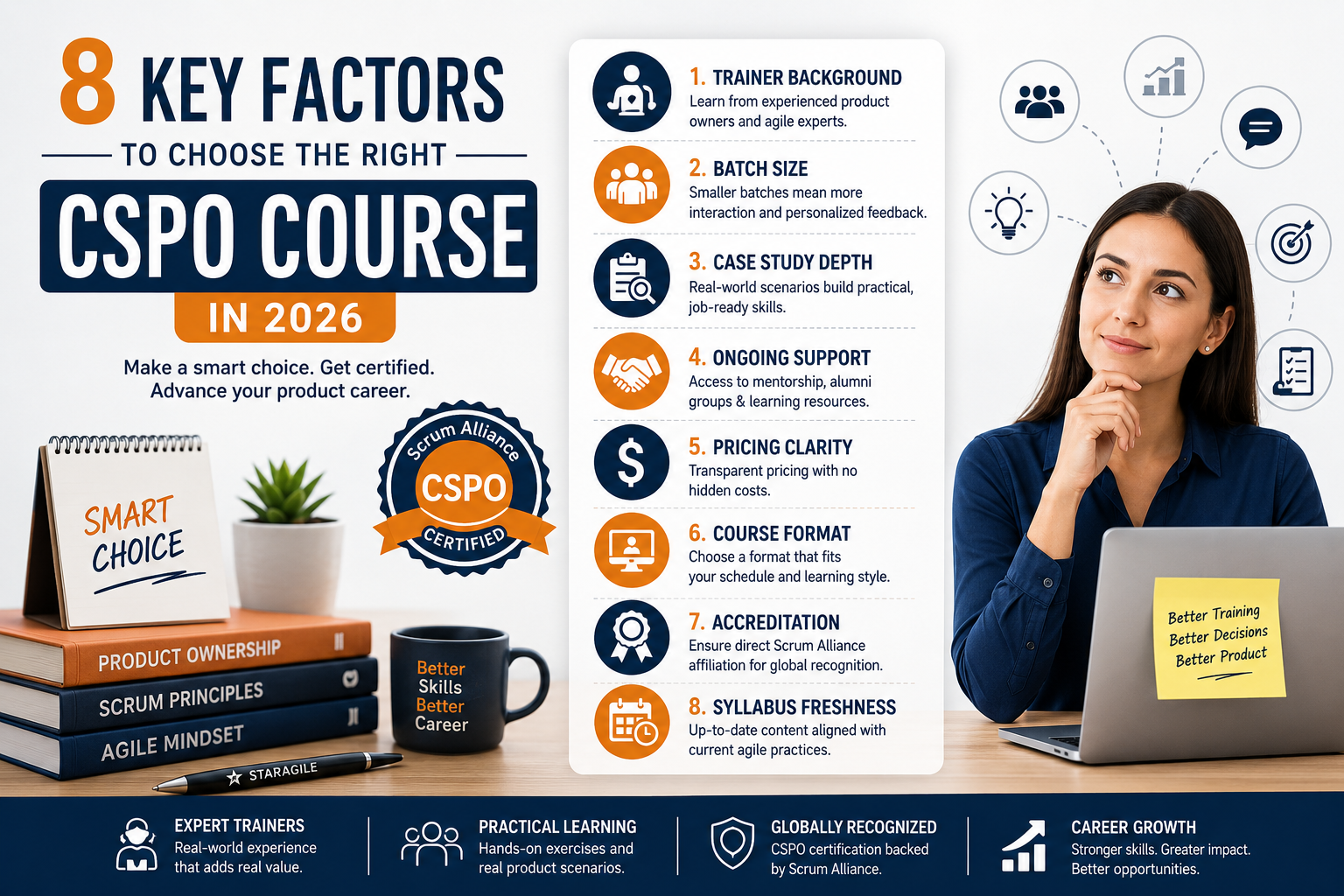
The right CSPO course comes down to eight practical checks: who’s training you, how big the batch is, whether the content is scenario-based, what support looks like after the workshop, how transparent the pricing is, whether the format suits your schedule, how recognised the certification body is, and how current the material actually is. Skip these checks, and you risk paying for a certificate that looks good on paper but teaches you very little. Let’s break each one down.
Who’s Actually Teaching the Workshop?
This is the first thing to check, and arguably the most important. A CSPO course has no formal exam, so your entire qualification rests on a two-day, trainer-led workshop. If the trainer has never actually held a product owner role, you’ll get definitions and diagrams instead of judgment calls. Ask providers directly whether their trainers have hands-on product ownership or agile coaching experience, not just a training certificate of their own.
Does a Smaller Batch Really Change the Outcome?
It does, more than people assume going in. Product ownership is a practical skill built through backlog exercises, prioritisation debates, and stakeholder role-play, not passive listening. In a packed session of 50 or more, you’ll get through the material but rarely get personalised feedback on your own user stories. Smaller batches mean more time for the trainer to correct your thinking, not just present slides at you.
How Much Weight Should Case Studies Carry?
Quite a lot, honestly. Scrum theory is easy to explain in an afternoon. Applying it to a backlog full of conflicting stakeholder demands is a different matter. A well-designed CSPO course leans heavily on live simulations, mock sprint planning, and case studies drawn from actual products, rather than hypothetical examples that never quite match real work. Before enrolling, ask what case studies the course actually uses.
What Kind of Support Should You Expect Once Training Ends?
Certification day shouldn’t be the last time you hear from your training provider. Better programs stay connected through alumni groups, refresher webinars, or informal mentoring as you step into your first product owner responsibilities. Given that CSPO comes bundled with Scrum Alliance membership, it’s also worth checking whether the provider helps you actually use that membership, rather than leaving the benefits unexplained.
Why Does StarAgile Show Up in So Many CSPO Comparisons?
If you’ve been researching training providers, StarAgile has probably crossed your radar more than once, and it’s worth understanding why. Their CSPO course is built around smaller live batches, trainers who’ve genuinely worked in product roles, and case studies drawn from real product teams rather than generic slide decks. Learners also keep access to study resources and a support community after the workshop ends, which tends to matter far more once you’re back at your desk trying to apply what you learned.
Does a Higher Price Always Mean a Better Course?
Not necessarily. Some providers cut prices by trimming trainer quality or squeezing more people into each batch, while others charge a premium mostly for brand recognition rather than substance. The better approach is comparing what each fee actually covers: trainer background, membership perks, retake policy, and post-course resources, instead of judging purely by the number on the invoice.
Which Factors Should You Prioritise? A Side-by-Side Look
| Factor | Why It Matters | Question to Ask the Provider |
| Trainer Background | Shapes real-world relevance of lessons | Have they worked as a product owner themselves? |
| Batch Size | Determines how much personal feedback you get | What’s the average number of learners per batch? |
| Case Study Depth | Builds practical, transferable skills | What real scenarios does the course use? |
| Ongoing Support | Helps you apply skills after training | Is there mentorship or an alumni network? |
| Pricing Clarity | Prevents hidden costs later | Does the fee include membership and materials? |
| Course Format | Affects how well it fits your schedule | Live online, in-person, or self-paced? |
| Accreditation | Confirms global recognition | Can they confirm direct Scrum Alliance affiliation? |
| Syllabus Freshness | Keeps skills relevant to current practice | When was the curriculum last revised? |
Does the Course Format Matter as Much as the Content?
Yes, particularly for working professionals. Live, instructor-led sessions consistently outperform pre-recorded video courses for something this interactive, since you can raise a question about your own backlog mid-session rather than pausing a video and hoping the next slide covers it. This is precisely why demand for CSPO Training in Australia has leaned toward flexible live formats rather than static, one-size-fits-all recordings.
Is It Worth Spending This Much Time Comparing Providers?
Absolutely. Product ownership today stretches well past writing user stories, touching customer analytics, stakeholder negotiation, and cross-team prioritisation. A properly run CSPO course, backed by an experienced trainer and solid case study work, prepares you for that wider scope. A rushed program with an oversized batch won’t. Spend the extra hour comparing providers properly. It’s a small effort next to what the right certification can do for your career.