

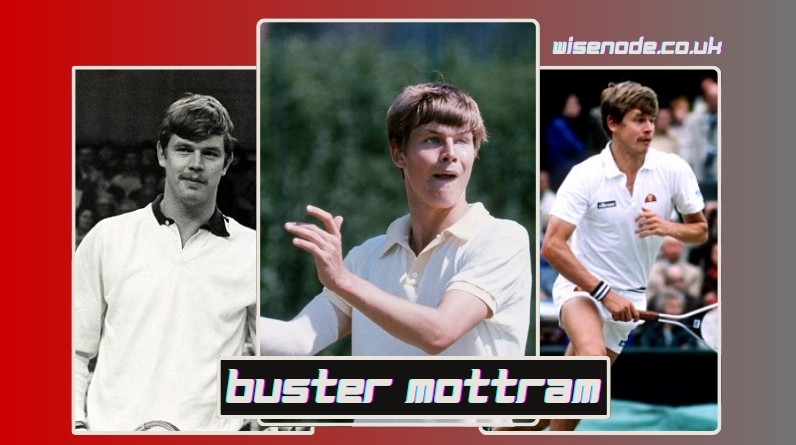
- Former British No.1 tennis player with a career-high ranking of World No. 15
- Active during the 1970s–early 1980s, representing Great Britain in the Davis Cup
- First British male player to rank inside the ATP top 100 as a teenager (1974)
- Known for strong performances at Wimbledon, French Open, and US Open
- Gained attention for outspoken political views beyond tennis
- Estimated net worth between $3M–$5M
- Lives a largely private life after retiring from professional tennis
Buster Mottram is a former British professional tennis player best known for being one of the UK’s top-ranked players during the 1970s and early 1980s. At a time when British men’s tennis lacked global dominance, he reached a career-high ranking of World No. 15 — a significant achievement that placed him firmly among the elite players of his era.
Beyond his on-court success, Mottram became a widely discussed public figure due to his outspoken political views. His legacy is shaped by both sporting excellence and controversy, making him one of the more complex personalities in British tennis history.
Quick Facts
| Full Name | Christopher “Buster” Mottram |
| Date of Birth | 25 April 1955 |
| Age | 70 (as of 2026) |
| Birthplace | Kingston upon Thames, England |
| Nationality | British |
| Profession | Former Professional Tennis Player |
| Years Active | Early 1970s – 1983 |
| Height | 1.93 m |
| Playing Style | Right-handed (one-handed backhand) |
| Highest Ranking | World No. 15 (July 1978 and February 1983) |
| ATP Singles Titles | 2 (singles); 5 (doubles) |
| Net Worth | $3M–$5M (estimated) |
Early Life & Background
Family Tennis Heritage
Buster Mottram was born into a tennis-focused family in Kingston upon Thames. His father, Tony Mottram, was a respected British tennis player and coach who reached the Wimbledon men’s singles quarter-finals three times in the late 1940s and early 1950s, while his mother, Joy Gannon Mottram, also competed at a high national level. This environment gave him early exposure to competitive tennis and first-rate technical training that most young players simply didn’t have access to.
His sister Linda Mottram also followed the family path, becoming a professional player who competed at Wimbledon alongside her brother in 1978. The Mottrams were, in many respects, one of Britain’s great tennis families.
That background mattered because it provided both access and discipline — two factors that often separate promising juniors from genuine elite professionals.
Education and Early Development
He attended King’s College School in Wimbledon, balancing academics with intensive tennis training. Being educated in the shadow of the All England Club placed him in one of the most competitive club tennis environments in the country — useful preparation for what was to come.
Junior Career Breakthrough
Mottram’s junior career offered early proof that he belonged at the top level. In 1972, he reached the Wimbledon Boys’ Singles final, where he lost to a young Björn Borg in a tight three-set match. The following year, he went one better at Roland Garros, winning the French Open Boys’ Singles title — a victory that made him only the second British player ever to claim that distinction.
These results were more than promising; they confirmed his ability to compete with the next generation of world-class talent before he’d even turned professional.
Career Journey
Turning Professional (Early 1970s)
Mottram turned professional in the early 1970s, entering a competitive era dominated by legends like Björn Borg, Jimmy Connors, and Guillermo Vilas. By 1974, he had already made history by becoming the first British male player to crack the ATP top 100 as a teenager — a distinction that spoke volumes about how quickly he had adapted to the professional game.
Rise in International Tennis (1975–1978)
His breakthrough at tour level came in 1975 when he won his first major title at the Johannesburg WCT event, defeating Tom Okker. That same year, he produced what many consider one of his most impressive early wins — a victory over recent Wimbledon champion Arthur Ashe at the inaugural Nations Cup in Kingston, Jamaica. He added a second singles title in Palma de Mallorca the following year.
These wins mattered because British players rarely achieved consistent success on the global circuit during this period. Mottram was, for a time, a genuine outlier.
Also Read: Gail Emms – Biography, Career & Net Worth
Peak Years and Ranking (Late 1970s–1983)
Mottram actually reached World No. 15 on two separate occasions — first in July 1978 and again in February 1983 — a detail that underlines just how consistently he maintained his level across nearly a decade at the top. He succeeded Mark Cox as British No. 1 and held that position for several years during British men’s tennis’s most competitive modern period.
Grand Slam Performances
- French Open: 4th Round (1977) — narrowly lost to reigning champion Adriano Panatta
- US Open: 4th Round (1980) — lost to Johan Kriek
- Wimbledon: 4th Round (1982) — lost to Tim Mayotte
While he did not win a Grand Slam, consistently reaching the fourth round across three different surfaces was a measure of real versatility. His 1977 French Open run was perhaps his finest, including wins over Patrick Proisy and Paolo Bertolucci — the latter of whom later admitted it was the most regrettable loss of his own career.
Davis Cup Contributions
Mottram’s Davis Cup record stands as perhaps the most enduring part of his sporting legacy. He represented Great Britain in 19 ties, compiling an impressive 31–10 overall record (27–8 in singles), and was central to Britain reaching the Davis Cup final in 1978. His finest individual moment may have come in September 1979 when, playing on clay at the Foro Italico in Rome, he dismantled the reigning French Open champion Adriano Panatta 6–0, 6–4, 6–4 — a result that shocked Italian tennis and captured headlines across Europe.
Contemporary observers noted that Mottram was one of those rare players for whom the responsibility of representing his country genuinely brought out the best in his game.
Retirement
He retired from professional tennis in September 1983, just seven months after achieving his second career-high ranking. By his own account, it was the relentless grind of international travel and the “hassle” of the tour schedule — rather than any decline in ability — that prompted him to step away. It was a notably candid reason for retirement, and one that reflected his character throughout his career.
Playing Style & Strengths
Technical Strengths
Mottram was known for his powerful serve, aggressive net approach, and sound baseline play. His one-handed backhand added variety, and his serve-and-volley instincts — somewhat old-fashioned even in his own era — gave him a distinctively attacking game plan.
Surface Adaptability
He performed well on both grass and clay, which was genuinely uncommon among British players of his generation. His preference for the clay court season, unusual for a British player raised near Wimbledon, contributed to results like his deep French Open run and the Rome Davis Cup heroics.
Competitive Edge
He was considered tactically astute, often relying on match awareness and positioning rather than brute power alone. His ability to lift his level in high-stakes Davis Cup ties, in particular, set him apart from teammates who were arguably more talented on paper.
Major Achievements & Highlights
- Career-high ATP ranking: World No. 15 (achieved twice — 1978 and 1983)
- 2 ATP singles titles; 5 ATP doubles titles
- British No.1 player during the late 1970s and early 1980s
- First British male teenager inside the ATP top 100 (1974)
- Won French Open Boys’ Singles title (1973)
- Davis Cup record: 31 wins, 10 losses across 19 ties
- Part of the British squad that reached the 1978 Davis Cup final
- Reached multiple Grand Slam fourth rounds across three surfaces
Taken together, these achievements highlight a player who was genuinely world-class at his peak — not merely a big fish in a small British pond.
Career Statistics Overview
Key Stats
- Career singles record: approximately 285–171
- Singles titles: 2 | Doubles titles: 5
- Peak ranking: No. 15 (reached on two occasions)
- Davis Cup singles record: 27–8
While modest by modern standards, these numbers reflect both the competitive depth of his era and the fact that players competed in far fewer annual tournaments than today’s professionals.
Politics & Controversies
Political Views
While still an active professional, Mottram became known for his outspoken right-wing political views. He publicly expressed support for the National Front, endorsed the policies of Enoch Powell, and — in an incident that caused significant friction with the British tennis establishment — signed a letter supporting Margaret Thatcher’s battles with the trade unions using his Davis Cup status. His inclusion in the 1978 Davis Cup squad drew protests outside the Redlands Tennis Club in Bristol from anti-fascist groups.
Attempts at Political Career
Mottram sought selection as a Conservative parliamentary candidate in several constituencies but was unsuccessful in each attempt. His political ambitions never translated into elected office.
UKIP Involvement
He later joined the UK Independence Party (UKIP) but was expelled in November 2008 after attempting to broker an electoral pact with the British National Party. UKIP leader Nigel Farage publicly described the overture as “astonishing” and reaffirmed the party’s position against any such association.
Impact on Reputation
These views often overshadowed his sporting achievements and continue to shape how he is discussed today. His relationship with the British tennis establishment was already fractious — John Lloyd once said Mottram had “gone too far, even by his own standards” — and his political activities deepened that divide considerably.
Also Read: Eddie Hearn – Biography, Career & Net Worth
Net Worth
Estimated Wealth
Buster Mottram’s net worth is estimated between $3 million and $5 million. The range reflects limited public financial disclosure rather than genuine uncertainty about his overall standing.
Income Sources
- Prize money from professional tennis tournaments
- Exhibition matches and appearances
- Coaching and commentary roles
- Long-term personal investments and financial planning
Compared to modern players, his tournament earnings were modest, reflecting the significantly lower prize money of the 1970s and early 1980s. That his estimated wealth remains substantial is a testament to prudent management over the decades since retirement.
Personal Life
Relationship Status
There is conflicting information regarding whether Mottram is or has been married. Some reports suggest he has a family, while others find no confirmed public record of a spouse. This uncertainty is consistent with his well-documented preference for privacy.
Family Background
His parents — Tony Mottram and Joy Gannon Mottram — were both accomplished tennis players who competed at national and international level. His sister Linda also played professionally. The family’s collective involvement in the sport is virtually unmatched in British tennis history across two generations.
Private Lifestyle
Mottram has maintained a low profile since retiring, rarely making public appearances and largely staying out of the spotlight.
Life After Tennis
Coaching and Commentary
After retiring, he remained peripherally involved in tennis through occasional coaching and media commentary, though he never pursued a high-profile coaching career in the way some contemporaries did.
Other Interests
He has spoken about interests in bridge and croquet — both games that reward the kind of strategic, patient thinking that also defined his approach on court. He also formed a notable songwriting partnership with entertainer Kenny Lynch, the two collaborating on the song “Average Man,” which added an unexpected creative chapter to his post-tennis life.
Latest Updates / Current Status
Recent Mentions
In recent years, Mottram’s name has surfaced occasionally in media discussions about British tennis history, Davis Cup heritage, and the political controversies of his playing era. He remains a reference point when British tennis’s past is examined in depth.
Current Life
Now in his seventies, he lives privately and is no longer active in professional tennis or mainstream public life. Turning 71 in April 2026, he has spent more than four decades away from the tour.
Lesser-Known Facts
- Won the French Open Boys’ Singles title in 1973 — only the second British player ever to do so
- Lost the 1972 Wimbledon Boys’ final to a teenage Björn Borg
- Was the first British male player inside the ATP top 100 as a teenager (1974)
- Beat reigning French Open champion Adriano Panatta 6–0, 6–4, 6–4 on Davis Cup duty in Rome in 1979
- Co-wrote the song “Average Man” with entertainer Kenny Lynch
- His Davis Cup singles record (27–8) is among the strongest in British tennis history
FAQs
Who is Buster Mottram?
He is a former British professional tennis player who reached a career-high ATP ranking of World No. 15 and represented Great Britain with distinction in the Davis Cup throughout the 1970s and early 1980s.
What was his highest ATP ranking?
He reached World No. 15 on two separate occasions — first in July 1978, and again in February 1983.
Is Buster Mottram married?
There is no clearly confirmed public record, and available sources provide conflicting information on the matter.
What is Buster Mottram’s net worth?
His estimated net worth ranges between $3 million and $5 million, based on available public information.
Why is he considered controversial?
He expressed support for the National Front and endorsed Enoch Powell’s policies during his playing career, and was later expelled from UKIP in 2008 for attempting to forge an alliance with the British National Party — a move publicly condemned by Nigel Farage.
What is he doing now?
He lives a private life and occasionally appears in discussions relating to British tennis history.
Was he banned from Wimbledon?
Claims have appeared in media reports, but details remain limited and the matter has not been widely or officially confirmed.
Conclusion
Buster Mottram remains a notable and complicated figure in British tennis history. Reaching World No. 15 — on two separate occasions — and compiling one of the strongest Davis Cup records ever seen from a British player, he performed at a level that few of his compatriots have matched before or since.
At the same time, his outspoken political views cast a long shadow over those achievements, shaping a public image that has never been straightforward. Teammate relationships were strained, the tennis establishment was repeatedly antagonised, and his post-playing political activities kept controversy close. Today, Mottram stands as both a genuinely accomplished athlete and a deeply polarising public figure — a reminder that sporting legacy and personal belief can intersect in ways that are rarely simple or comfortable.
For readers exploring British tennis history, his story offers an unusually candid window into both the sport’s evolution and the strong personalities who shaped it.