

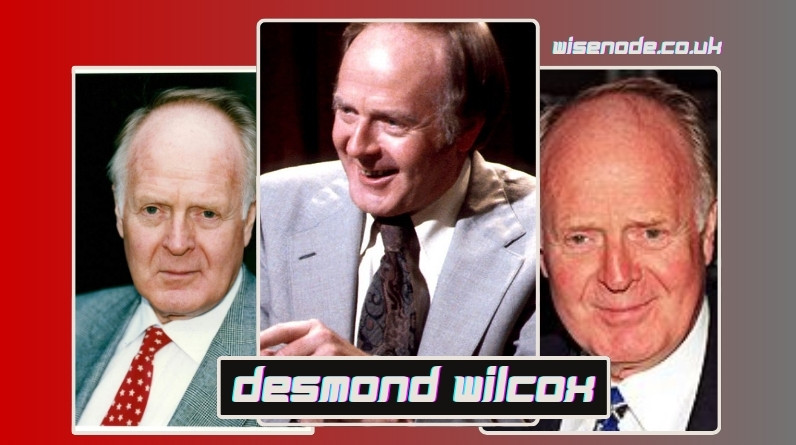
- British documentary filmmaker and TV producer known for human-interest storytelling
- Born May 21, 1931 – died September 6, 2000 (aged 69)
- Key figure behind BBC’s Man Alive and observational documentaries
- Married to Esther Rantzen; father of six children
- Pioneered storytelling techniques still used in modern television
- Remembered for bringing real human experiences to mainstream media
Desmond Wilcox was a highly influential British television producer and documentary filmmaker who helped redefine how real-life stories were told on screen. Best known for his work on Man Alive, he played a major role in shaping human-interest television in the UK. His approach focused on authentic, everyday experiences — an approach that later influenced modern documentary and reality programming.
What set Wilcox apart was not just what he filmed, but how he filmed it. He believed that ordinary people had extraordinary stories worth telling, and his work brought those voices into millions of homes across Britain.
Quick Facts
| Full Name | Desmond John Wilcox |
| Date of Birth | May 21, 1931 |
| Age at Death | 69 years (died September 6, 2000) |
| Birthplace | Welwyn Garden City, England |
| Nationality | British |
| Profession | Television Producer, Documentary Filmmaker, Journalist |
| Years Active | 1948 – 2000 |
| Spouse | Esther Rantzen (also previously married to Patsy Price) |
| Children | 6 |
| Net Worth | Not publicly disclosed |
Early Life & Background
Childhood and Upbringing
Desmond Wilcox was born in 1931 in Welwyn Garden City, England, during a period of profound social change in Britain. Growing up in the post-war era brought him face to face with real-life struggles and resilience — experiences that would quietly shape both his worldview and his storytelling instincts.
Early Interest in Storytelling
From a young age, Wilcox showed a clear pull toward journalism and real-world narratives. Rather than fictional storytelling, he was drawn to real people and real events — an instinct that became the bedrock of his entire career.
Education and Influences
Wilcox attended Pate’s Grammar School, and his early work in print journalism suggests a rigorous grounding in writing, observation, and reporting. These skills proved invaluable when he later made the leap into television documentaries, where precision and empathy had to work together on screen.
Career Journey
Early Journalism Career (1948–1950s)
Wilcox began his professional life in 1948 as a reporter on a local weekly newspaper. He also briefly worked as a deckhand in the merchant navy — a stint that gave him a grounded, first-hand understanding of ordinary working lives before he’d ever pointed a camera at one.
After completing national service, he joined Fleet Street and worked with the Daily Mirror, becoming their youngest-ever foreign correspondent based in the New York bureau. That transatlantic perspective widened his sense of what human stories could look like on a global scale.
Transition to Television (1960s)
In 1960, Wilcox moved into television, joining ITV’s current affairs programme This Week. It was a turning point — here he could combine the rigour of print journalism with the immediacy of the moving image. Five years later, he joined the BBC, where some of his most important work would take shape.
Breakthrough with Man Alive
Wilcox became widely known through Man Alive, a landmark BBC2 series that launched on 4 November 1965. As co-editor and presenter, he helped define its direction, tone, and moral compass from the outset. Originally commissioned by David Attenborough during his time as Controller of BBC2, the series ran until 1982, producing nearly 500 programmes across social and political topics both in the UK and abroad.
The show focused on real people and real problems, offering something closer to emotional truth than traditional news programmes ever attempted. That approach resonated — and set new standards for what documentary television could achieve. Wilcox himself summed up the philosophy plainly: real life, honestly portrayed, is sufficiently dramatic in itself.
After leaving BBC staff, Wilcox formed the Man Alive Group, an independent production company, continuing to develop the observational approach he had pioneered at the corporation.
Leadership Roles at the BBC
Between 1972 and 1980, Wilcox served as Head of General Features at the BBC — a role that gave him influence not just over individual programmes, but over the entire direction of factual television at the corporation. He oversaw series including Americans, Black in Blue, The Visit, and A Day in the Life, expanding his storytelling across different cultures and formats. He also wrote the book Explorers (BBC, 1975), based on the television series of the same name.
Later Career and Notable Projects
One of his most celebrated later works was The Boy David, a documentary series following David Lopez — a young Peruvian boy abandoned as a baby who had a condition destroying his face — whose reconstruction was performed by a Scottish surgeon who later adopted him. The series drew nearly eight million viewers for its BBC1 screening and won six international awards. Reviews at the time were extraordinary, with critics calling it one of the greatest documentaries ever made.
This work confirmed what colleagues had long understood: Wilcox had a rare ability to handle deeply sensitive subjects with compassion and humanity, while still holding the attention of a mass audience.
Major Works & Achievements
Key Television Programs
- Man Alive (1965–1982) – A pioneering human-interest series, nearly 500 programmes across 17 years
- This Week – Early current affairs programme at ITV
- That’s Life! – Produced alongside Esther Rantzen
Influential Documentaries
- The Family – Early example of observational “fly-on-the-wall” television
- The Boy David – Award-winning international documentary series, six international awards
Awards and Recognition
Wilcox received six international awards for The Boy David alone. He served on the BAFTA council, reflecting the esteem in which the industry held him throughout his career. Posthumously, he was awarded the Grierson Documentary Film Awards Life Tribute in November 2001 — one of the highest honours in British factual filmmaking.
Documentary Style & Influence
Human-Interest Storytelling
Wilcox focused on everyday people rather than celebrities or sensational topics. It was a deliberate and principled choice — one that made his work relatable, emotionally grounded, and genuinely trusted by audiences who saw their own experiences reflected on screen.
Observational Techniques
He was an early champion of the “fly-on-the-wall” approach, where the camera observes without interference or direction. This created a quality of realism that audiences instinctively responded to — a feeling that what they were watching was actually happening, not being performed.
Impact on Modern Television
Many modern documentary and reality TV formats trace a direct line back to Wilcox’s methods. His work proved something that wasn’t obvious at the time: authentic storytelling could attract large audiences without sensationalism or manufactured drama. That remains one of the most important lessons in the history of British television.
Net Worth
Desmond Wilcox’s net worth was never publicly disclosed. Unlike many modern media figures, financial details were not widely reported during his career.
His influence in British television and his leadership roles at the BBC nonetheless point to a long and well-established career spanning five decades.
Personal Life
Marriage to Esther Rantzen
Wilcox was married to television presenter Esther Rantzen, one of British broadcasting’s most recognisable figures. Their relationship was both personal and professional — they collaborated on media projects and shared a long-standing commitment to social issues and public interest broadcasting.
First Marriage
Before Rantzen, he was married to Patsy Price for over two decades. The couple had three children together.
Children and Family
Wilcox had six children in total across both marriages. Despite the demands of a high-profile career, those who knew him spoke consistently of his warmth and his investment in family life.
Charity Work
He was actively involved in charitable causes, including serving as chairman of Defeating Deafness and supporting heart-related charities — causes that aligned closely with the social conscience visible throughout his documentary work.
Also Read: Carol Kirkwood – Biography, Career & Net Worth
Death & Cause
Desmond Wilcox passed away on September 6, 2000, at the age of 69, following a long battle with coronary heart disease that had included multiple surgeries over the years. He died in Paddington, London.
His death prompted an outpouring of tributes across British broadcasting, with colleagues, journalists, and public figures reflecting on both his professional achievements and the personal generosity he brought to everything he did.
Legacy & Impact
Wilcox’s influence extends far beyond the programmes he made. He helped establish a style of television that places empathy, authenticity, and human dignity at its centre — values that were not yet standard when he started out, and that became so partly because of his work.
His legacy also lives on in a more unusual way: in 2023, Wilcox was portrayed by actor Adam James in the ITV1 drama The Long Shadow, introducing him to a new generation of viewers decades after his death. Posthumously, the College of Arms also granted a coat of arms in his name, recognising his contributions as a journalist and broadcaster — a rare honour for a figure from the media world.
Also Read: Karl Howman – Biography, Career & Net Worth
Latest Updates / Current Status
Although Desmond Wilcox passed away in 2000, his work continues to be referenced in discussions about the evolution of factual television. Man Alive in particular is cited regularly as a founding text of the access documentary tradition, and The Boy David remains one of the most acclaimed British documentaries ever made.
His legacy also continues through the charitable causes he championed and through the ongoing public work of his family — most notably Esther Rantzen, who has remained one of Britain’s most prominent voices on issues of social welfare and public service.
Lesser-Known Facts
- Worked as a deckhand in the merchant navy before entering journalism
- Became the youngest-ever foreign correspondent for the Daily Mirror, based in New York
- Converted to Judaism later in life
- Wrote the book Explorers (BBC, 1975), based on the television series of the same name
- Was portrayed posthumously by actor Adam James in the 2023 ITV drama The Long Shadow
- Was a long-standing member of the BAFTA council
- A media arts centre at a high school in Rainhill, Merseyside, was named in his honour
FAQs
Who was Desmond Wilcox?
Desmond Wilcox was a British television producer and documentary filmmaker known for pioneering human-interest storytelling on television, particularly through his landmark BBC series Man Alive.
What was Desmond Wilcox famous for?
He was best known for his work on the BBC series Man Alive and for introducing observational documentary techniques to mainstream British television.
What happened to Desmond Wilcox?
He died on September 6, 2000, after a long battle with coronary heart disease. He was 69.
Who was Desmond Wilcox’s wife?
He was married to television presenter Esther Rantzen. He was previously married to Patsy Price, with whom he had three children.
How many children did Desmond Wilcox have?
He had six children from his two marriages.
What are his most notable documentaries?
His most notable works include Man Alive, The Family, and The Boy David, the last of which won six international awards.
Conclusion
Desmond Wilcox remains one of the most important figures in British documentary television. Through his commitment to authentic storytelling, he changed the way audiences connect with real-life narratives — shifting television away from the detached and informational, and towards the deeply human.
His legacy is not simply in the programmes he created, but in the storytelling standards he set — standards that continue to shape how factual television is made and valued today.